How to Create a Professional Yoga Teacher Invoice — And Get Paid Without the Awkwardness
Yoga teachers are some of the most underpaid and under-invoiced professionals in the wellness industry. The work is physically and energetically demanding, the preparation is real, and the impact on clients is lasting — but the business side, especially invoicing, often gets treated as an afterthought or handled with a level of informality that costs teachers real money.
Whether you teach private sessions, group classes, corporate wellness programs, retreats, or online courses, having a clear, professional yoga teacher invoice is not just about looking organised — it is about being paid correctly, on time, every time.
Your yoga practice is your profession. Invoice it like one.
Why Yoga Teachers Struggle With Invoicing
The most common invoicing problems yoga teachers face are not about capability — they are about systems:
Charging inconsistently — different rates for the same session type with different clients
Not invoicing at all — operating on a trust basis that payment will arrive, then chasing informally
Under-describing services — writing ‘yoga class’ instead of specifying session type, duration, and date
No record of what was agreed — leading to disputes about how many sessions were booked vs. delivered
No tax tracking — accumulating income without monitoring what portion needs to be set aside for tax
A proper yoga teacher invoice solves all of these at once. It creates a clear, written record of what was agreed, what was delivered, and what is owed — removing ambiguity from the client relationship entirely.
What a Yoga Teacher Invoice Should Include
A professional yoga teacher invoice is not complicated, but it needs to cover the right ground:
Your name or studio name, contact details, and any applicable tax registration number
Your client’s name and contact details
Invoice number and invoice date
Clear description of services — session type (private, group, corporate), duration, and date or date range
Rate per session, number of sessions, and subtotal
Package rates if billing a block of sessions at a bundled price
Tax line if applicable — VAT, GST, or sales tax at your jurisdiction’s rate
Total amount due
Payment due date and payment method — bank transfer details, payment link, or preferred method
Cancellation policy note if relevant
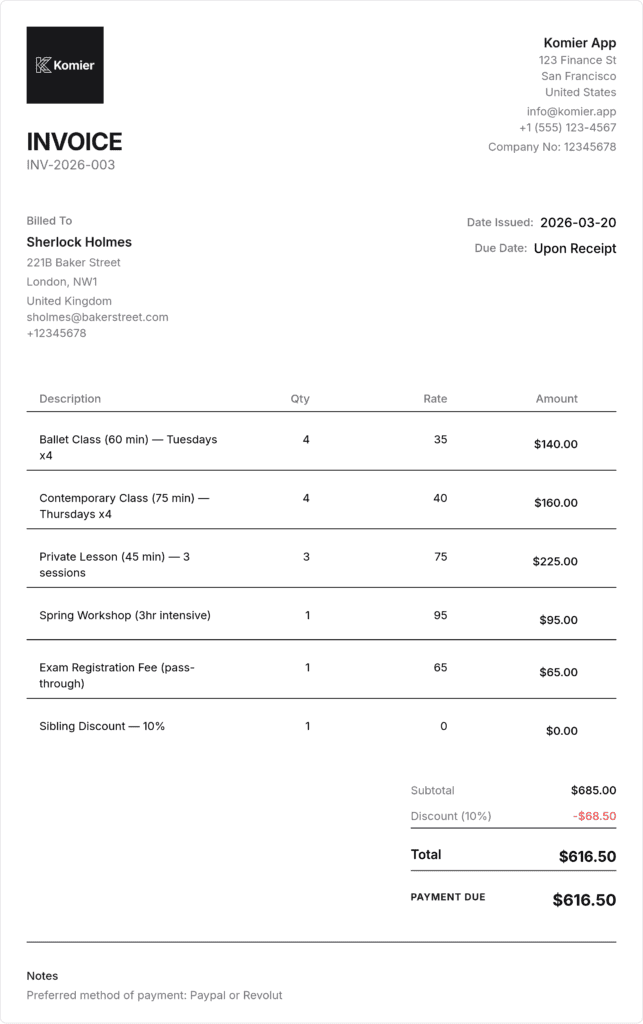
Sample Yoga Teacher Invoice — Built in Komier
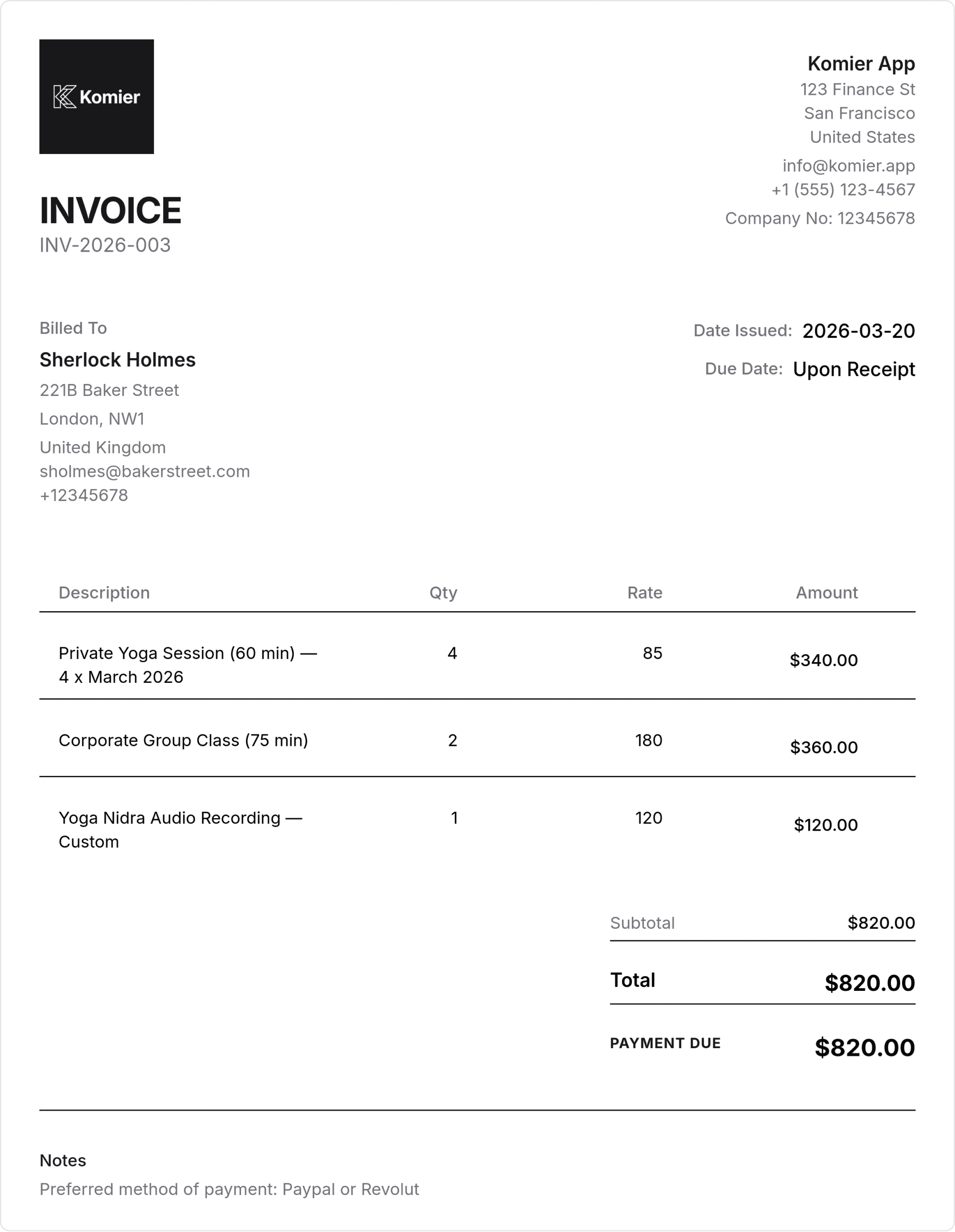
Here is what a professional yoga teacher invoice looks like when generated through Komier. Every item is saved in your inventory so you select rather than retype.
Invoicing for Different Yoga Business Models
Private one-to-one sessions
Save each session type in your Komier inventory — 60-minute private, 90-minute private, online session — with your standard rate for each. When invoicing a client at the end of the month for multiple sessions, select the item, set the quantity to the number of sessions completed, and Komier calculates the total. Include session dates in the description field for complete clarity.
Block bookings and packages
Many yoga teachers sell blocks of sessions — 5 sessions, 10 sessions, a month-long package. Save these as inventory items at their block rate. When the client books a new block, generate an invoice for the package upfront. Note in the description how many sessions are included and any expiry terms.
VAT and PAYE complexity
Tax compliance in Africa varies significantly by country but almost universally involves VAT, PAYE on employee earnings, and often pension contribution requirements. Financial tools need to support configurable tax rates and clear payslip deduction structures to be genuinely useful for African employers.
Group classes and drop-in rates
For studio or independent group classes, invoice the studio or employer for the class rather than individual students if you are being paid by the venue. Save your per-class rate in inventory and invoice monthly for all classes taught. If you run your own drop-in classes, invoice individual students at your session rate.
Corporate wellness programs
Corporate clients often require a more formal invoice — with a purchase order reference, the company’s billing address, and sometimes VAT details. Komier’s client management handles all of this: save the company as a client with their full billing details, and they fill in automatically every time you invoice them. Corporate clients also often have 30-day payment terms — set this as your due date when generating the invoice.
Retreats and intensives
Retreat invoicing often involves a deposit followed by a balance payment. Generate two separate invoices in Komier: one for the deposit amount at booking (clearly labelled ‘Deposit — [Retreat Name]’) and one for the remaining balance at the agreed due date. This creates a clear payment trail and professional documentation for both parties.
Online courses and digital products
If you sell pre-recorded courses, digital guides, or membership access, these are products rather than services. Save them as inventory items in Komier at their sale price. Generate an invoice when a client purchases access — clean documentation that also feeds directly into your revenue dashboard.
In most jurisdictions, yoga teaching is a service subject to whatever sales tax or VAT applies to professional services in your country. However, some jurisdictions exempt educational or wellness services. Always confirm your tax obligations with a local accountant before deciding whether to charge tax on your invoices. Once confirmed, configure your rate in Komier's Tax Settings and it applies automatically.
Getting Paid on Time — The Professional Approach
Yoga teachers commonly struggle with late payment because the nature of the work makes it feel awkward to be business-like about money. A professional invoice removes this awkwardness by doing the asking on your behalf. Some habits that help:
Invoice immediately after delivering sessions — not at the end of the month when the memory of the session has faded for the client
Set clear payment terms on every invoice — 7 days is standard for individual clients, 14 to 30 days for corporate
Include your payment method prominently — bank details, a payment link, or your preferred platform — so clients have no reason to delay
Use Komier’s Notes feature to set a reminder the day after the due date — if payment has not arrived, follow up promptly
Tracking Your Yoga Business Finances With Komier
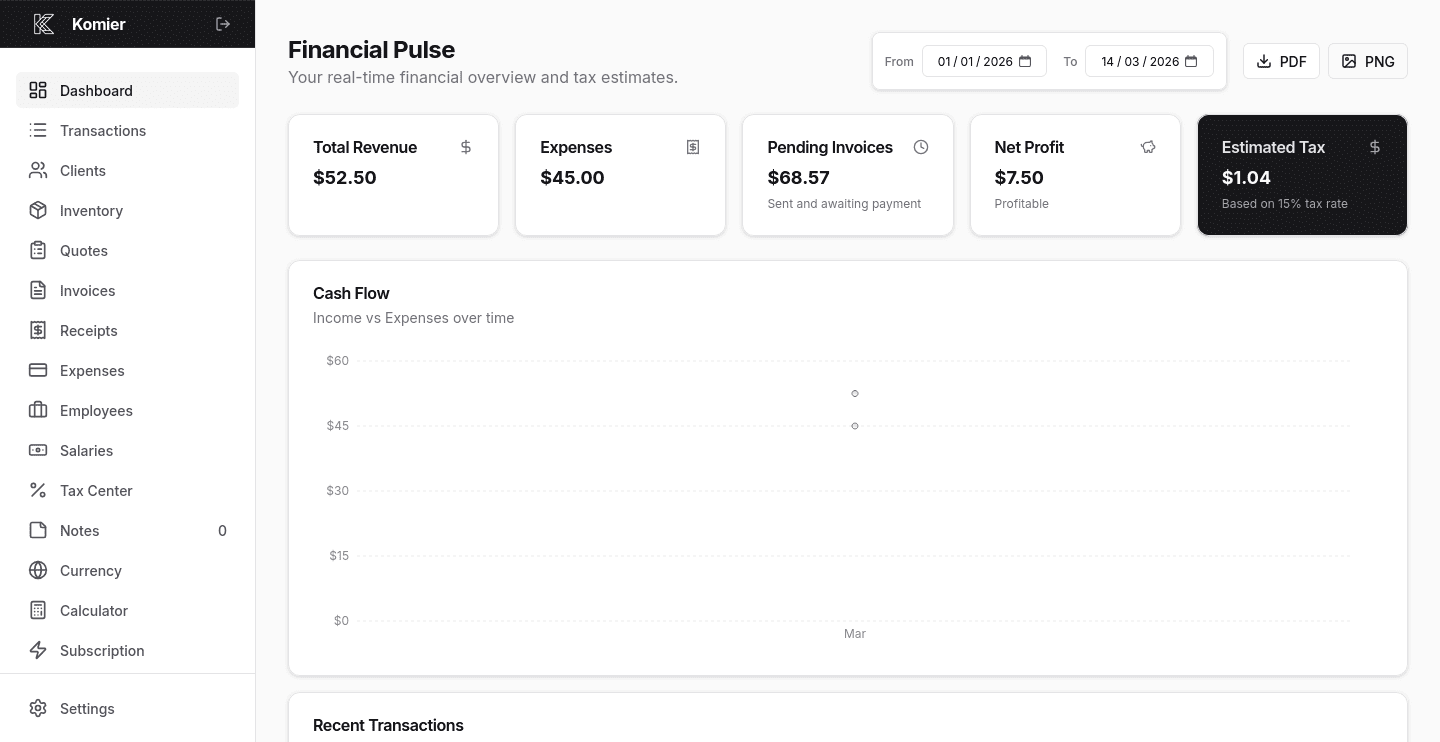
Beyond invoicing, Komier gives yoga teachers a real-time view of their teaching business finances — something very few independent teachers have:
Revenue dashboard — see your total teaching income for the month, quarter, or year at a glance
Expense tracking — log studio rental, insurance, training courses, props, and equipment as deductible business expenses
Tax estimate — know your approximate tax liability at any moment so the year-end payment is never a surprise
Invoice history — every client, every session, every payment in one place