How to Create a Professional Graphic Design Invoice — Because Your Creative Work Deserves a Business Brain
Graphic designers are paradoxically the professionals who most often have the least professional financial documentation. The work is visually meticulous — every pixel considered, every typeface deliberate — but the invoice that represents that work is frequently an afterthought: a plain text email, a generic PDF, or worse, a verbal agreement with a handshake and a hope.
This matters beyond aesthetics. A poorly documented invoice is a payment dispute waiting to happen. It is unpaid overtime absorbed into a flat fee. It is scope creep with no financial consequence for the client. A professional graphic design invoice is the business infrastructure that makes creative work sustainable.
The best designers know that a great invoice is part of the creative brand you present to every client.
The Specific Invoicing Challenges for Graphic Designers
Creative work is subjective — without clear deliverable descriptions, clients can dispute what was agreed
Revisions are a constant and often unpaid drain unless explicitly addressed on the invoice
Different pricing for different usage rights — logo use for print vs. digital vs. global licensing — is rarely documented
Rush fees and additional rounds of amends are difficult to charge for without a pre-established structure
International clients create currency complexity for designers working across markets
What a Graphic Design Invoice Should Include
Your designer name or studio name, logo, contact details, and tax information
Client name and full billing address
Invoice number and date
Project name and any client reference or PO number
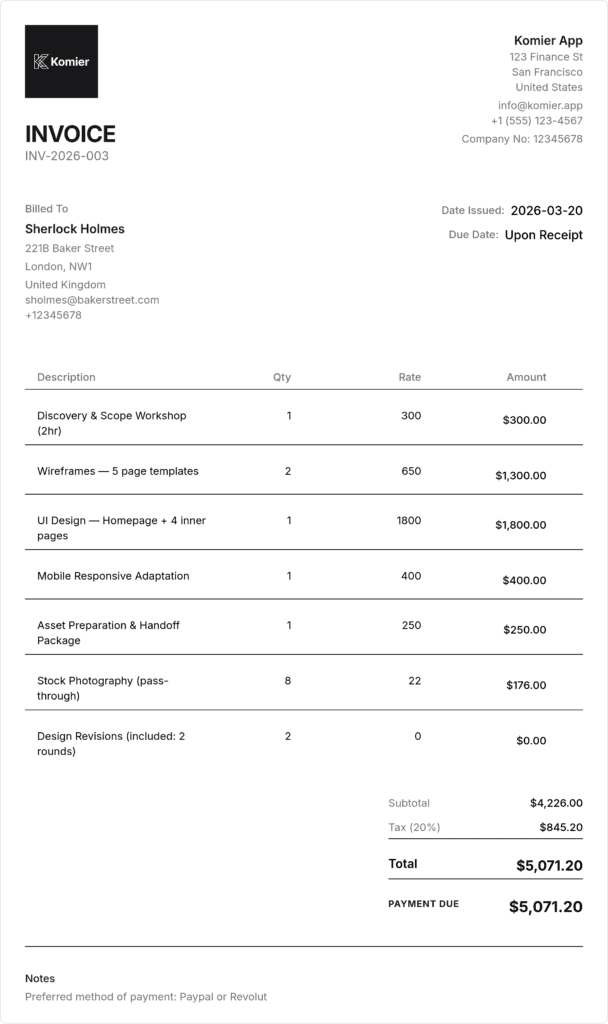
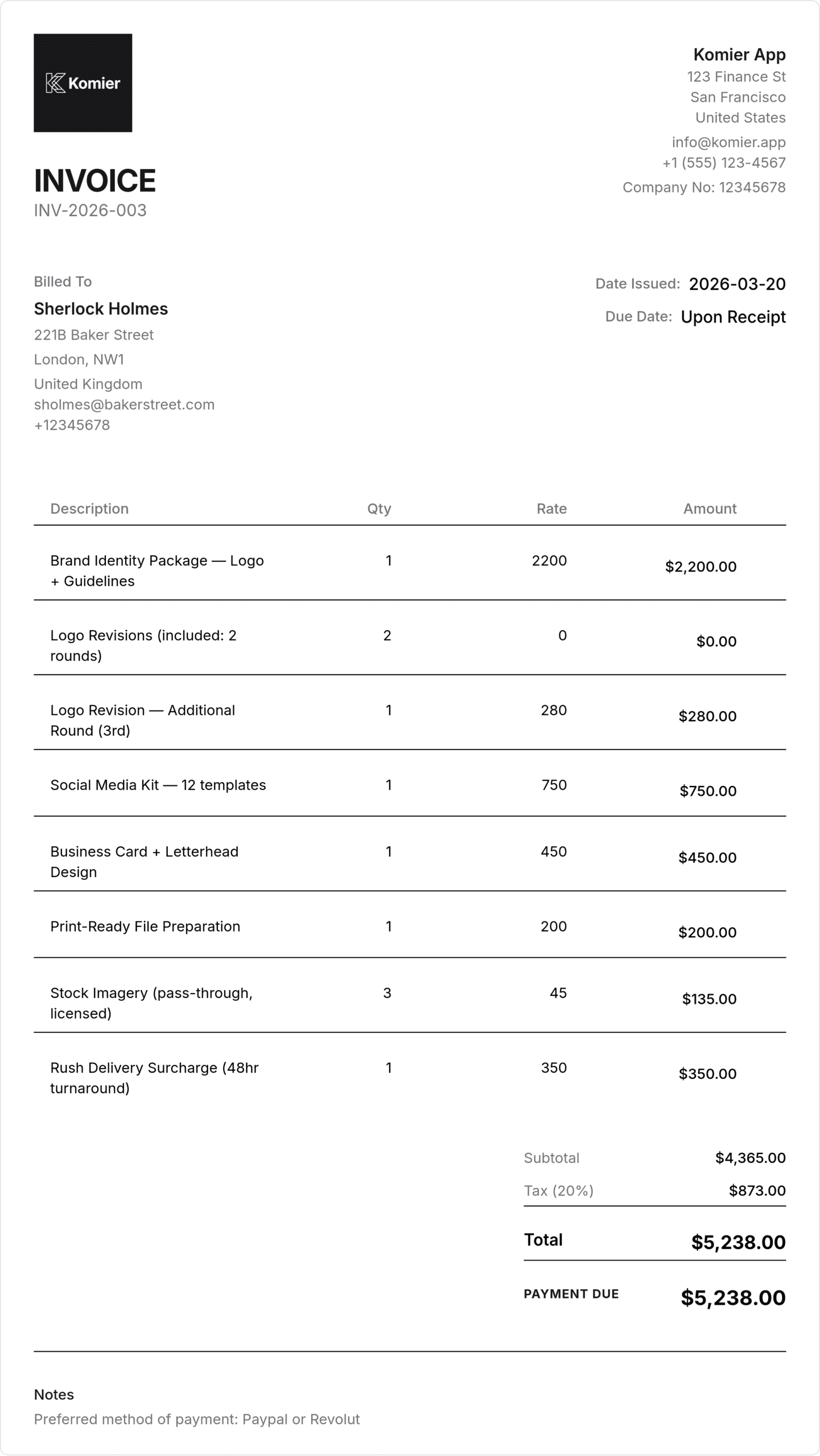
Detailed description of each deliverable — not just ‘Logo Design’ but ‘Primary logo mark, 3 colour variants, black and white version, file formats: AI, EPS, PNG, SVG’
Revision rounds included — and charges for additional rounds
Usage rights granted if applicable — scope of licence for the delivered assets
Any pass-through costs — stock imagery, font licences, print proofing
Rush fee line item if applicable
Tax at applicable rate
Total amount due, payment terms, and payment method
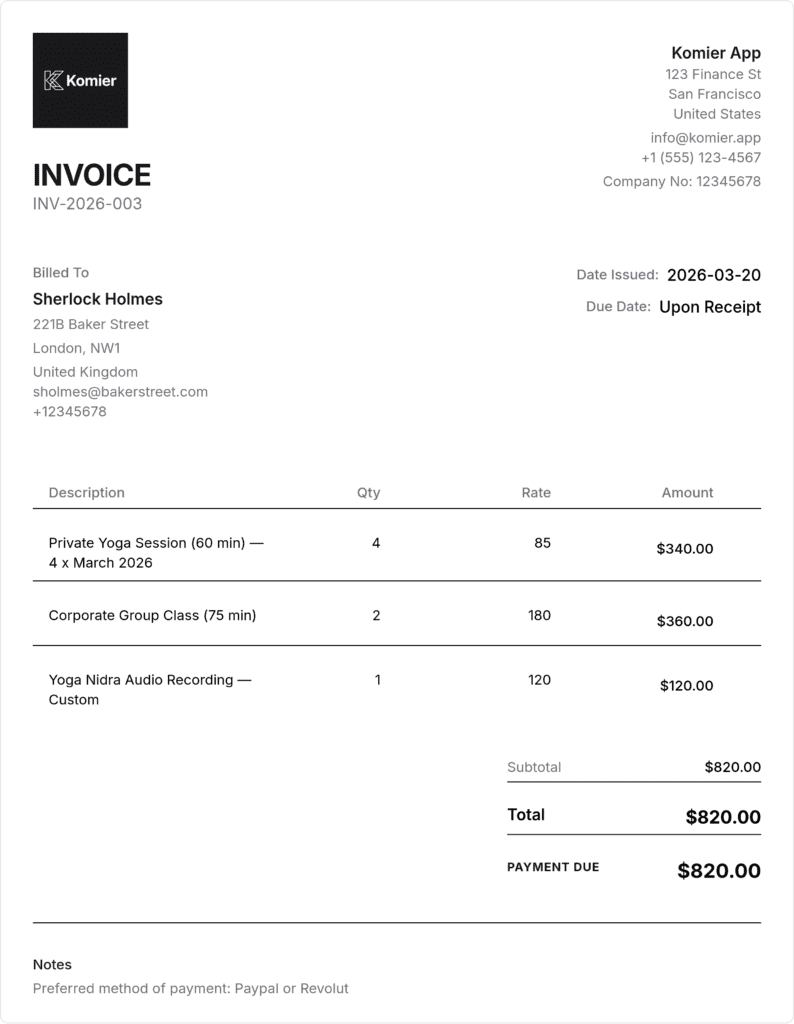
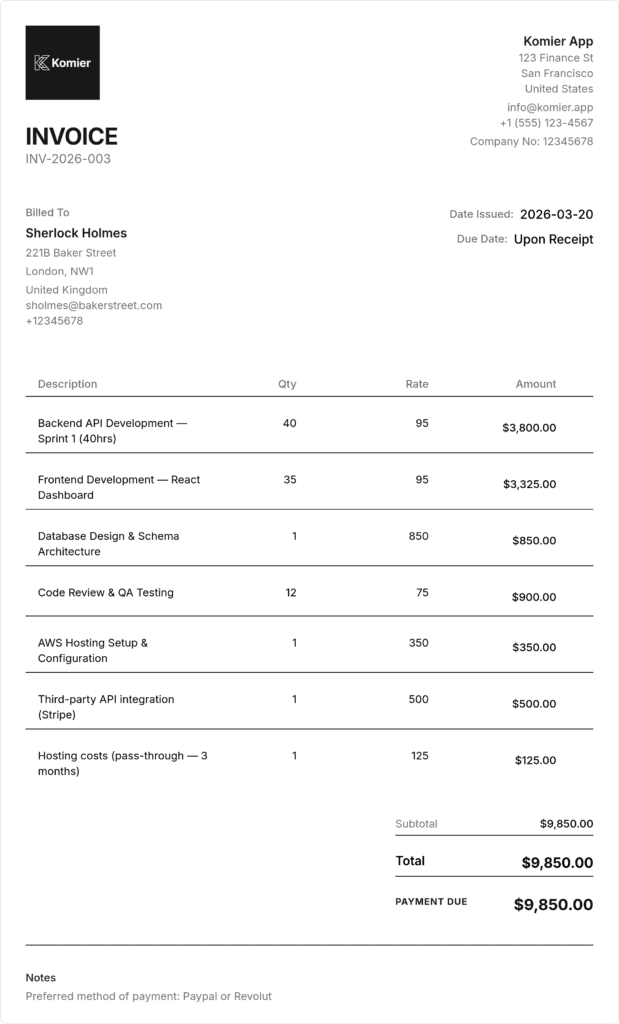
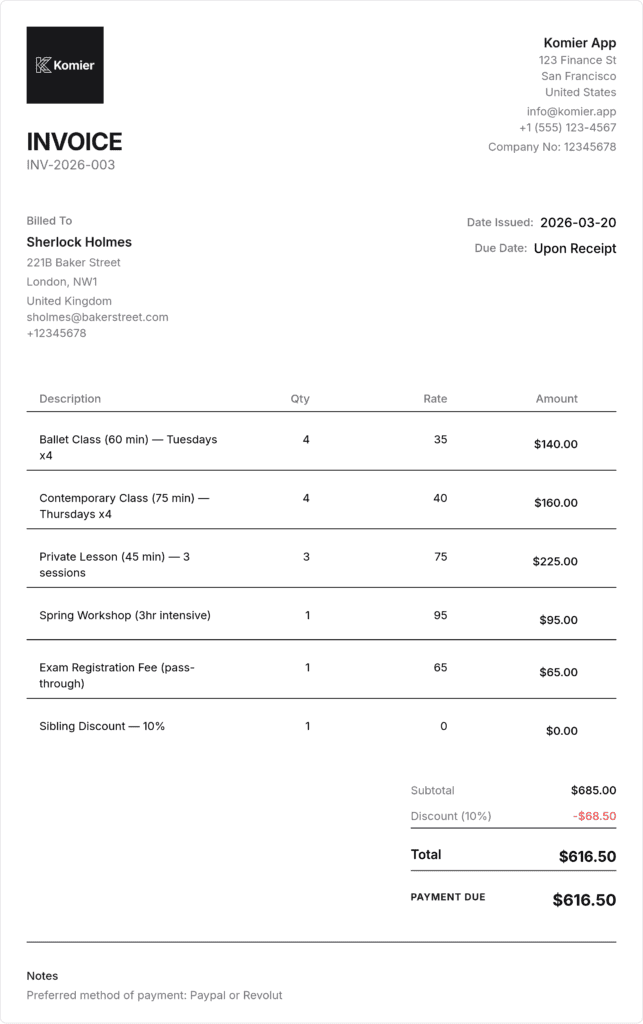
Sample Graphic Design Invoice — Built in Komier
Invoicing Structures for Graphic Designers
Project-based fixed fees
Logo design, brand identity, brochure design, packaging — these are typically charged as fixed project fees. The key to invoicing these professionally is breaking the total into meaningful line items rather than a single number. This transparency does two things: it shows the client the scope of work they received, and it makes any additional requests clearly chargeable because they fall outside the documented scope.
In Komier, save each standard deliverable as an inventory item — ‘Logo Design Package’, ‘Business Card Design’, ‘Brand Style Guide’, ‘Social Media Template Set’ — at your standard rate. Building a project invoice becomes selecting items from your library in seconds.
The revision clause on your invoice
Every graphic design invoice should show revision rounds explicitly — even when they are included at zero charge. ‘Logo Revisions — 2 rounds included — $0.00’ on your invoice sets a clear expectation that further revisions beyond those two rounds will be charged. Save an ‘Additional Revision Round’ item in Komier’s inventory at your applicable rate. When the client requests a third round, generate the charge immediately — it is documented, professional, and not a surprise.
Hourly rate work
For smaller tasks, amendments, consultancy, or art direction work billed by the hour, save your hourly rate as an inventory item. Log hours as a quantity and include the date range and brief description of work completed in each line item. Invoicing every two weeks or monthly depending on volume keeps amounts manageable and payment timelines predictable.
Retainer arrangements
Many graphic designers work with regular clients on monthly retainers — a set number of hours or deliverables per month in exchange for a fixed monthly fee. This is the most financially stable model and the easiest to invoice: a single recurring invoice at the start of each month. Save the retainer as an inventory item in Komier and generate it monthly in under a minute.
Licencing and usage rights
If your contracts include usage rights for the work delivered — print rights, digital rights, global licencing, perpetual vs. time-limited use — these can be documented on the invoice as separate line items. ‘Global digital usage rights — unlimited duration’ at an agreed fee creates a clear record that both parties have agreed to the terms, separate from the design work itself.
Multi-Currency Design Invoicing
Graphic designers frequently work internationally — particularly designers in India, Eastern Europe, Southeast Asia, and Latin America who serve US and European clients. Komier handles multi-currency invoicing natively: generate invoices in USD, EUR, or GBP for international clients and track your local currency expenses on the same dashboard.
As a designer, your invoice is a client-facing document that reflects on your professional brand. In Komier, add your studio logo to your business profile and it appears automatically on every invoice you generate — your branding is consistent across every touchpoint, including the bill.
Protecting Yourself: Deposit Invoices
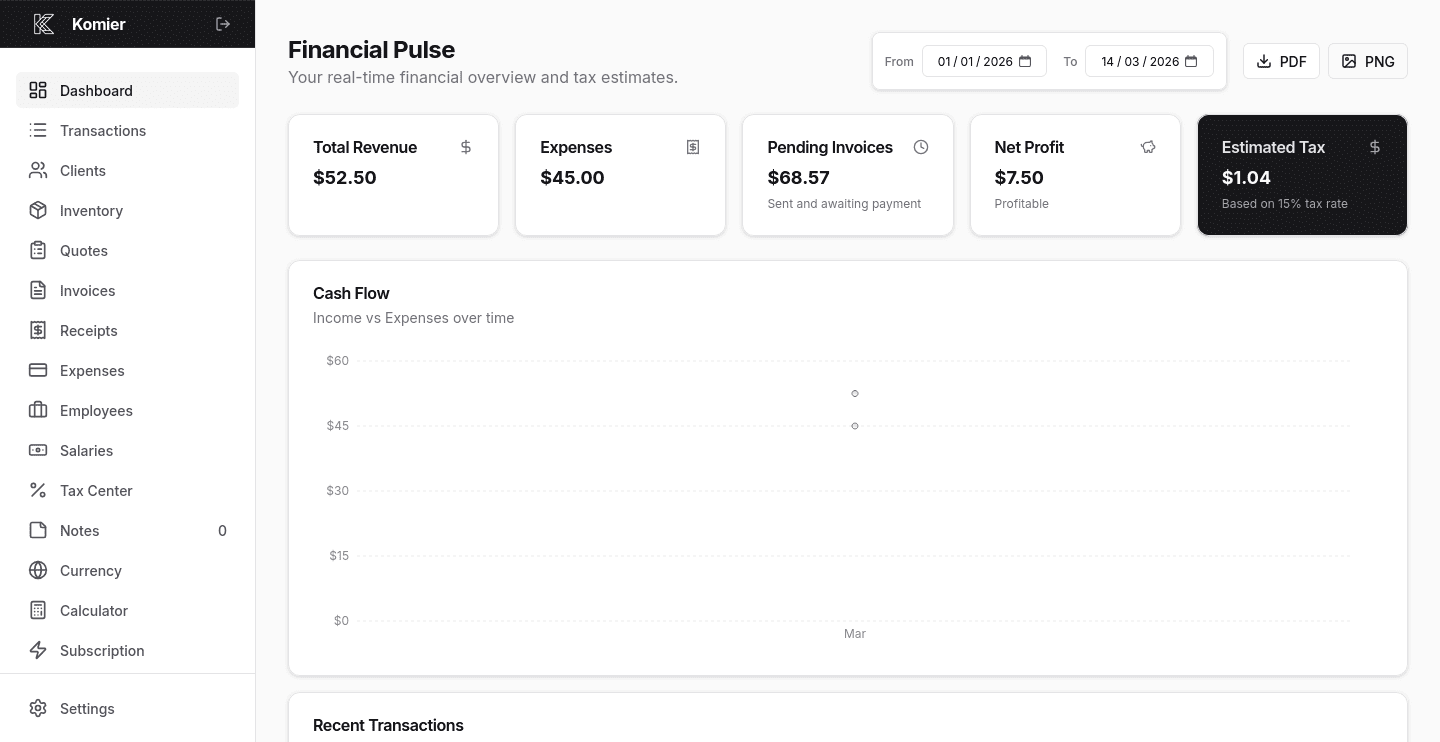
Always collect a deposit before starting work on a new project. For graphic design, 50% upfront is the professional standard. Generate a deposit invoice in Komier labelled clearly as ‘Project Deposit — [Project Name] — 50%’. Do not start work until the deposit invoice is marked as paid. The final invoice for the balance is generated on delivery or sign-off.