How to Create a Professional Dance Teacher Invoice — Get Paid for Every Lesson, Every Time
Dance teachers are artists, coaches, and small business owners all at once — often without the business training that the last part of that description requires. Teaching dance is the work. Invoicing for it is the business. And the business side matters, because an unpaid lesson is not just inconvenient — it is your time, your expertise, and your livelihood.
Whether you teach ballet, contemporary, salsa, hip hop, ballroom, flamenco, or any other discipline — privately, in studios, in schools, or online — a professional dance teacher invoice creates the financial clarity that makes your teaching career sustainable.
Every lesson you teach is a professional service. Invoice it with the same professionalism you bring to the studio floor.
The Invoicing Reality for Dance Teachers
Most dance teachers start their invoicing life with one of three systems: cash in an envelope, bank transfer with a text message as the paper trail, or a class payment app that takes a commission on every transaction. None of these give you what a professional invoice provides: a clear, formal record of what was agreed, what was delivered, and what was paid.
The dance teaching business also has specific financial complexity that other service businesses do not always share:
Variable student attendance — students miss classes, make up sessions, and reschedule frequently
Mixed billing structures — per-class drop-in rates, monthly packages, and private lesson rates often coexist
Venue hire costs that are sometimes passed to students and sometimes absorbed
Summer intensives, workshops, and one-off events alongside regular class schedules
Studio or school employment alongside private teaching creates multiple separate income streams
What a Dance Teacher Invoice Should Include
- Your name or dance school name, contact details, and any applicable tax information
- Student or parent name and billing contact details
- Invoice number and invoice date
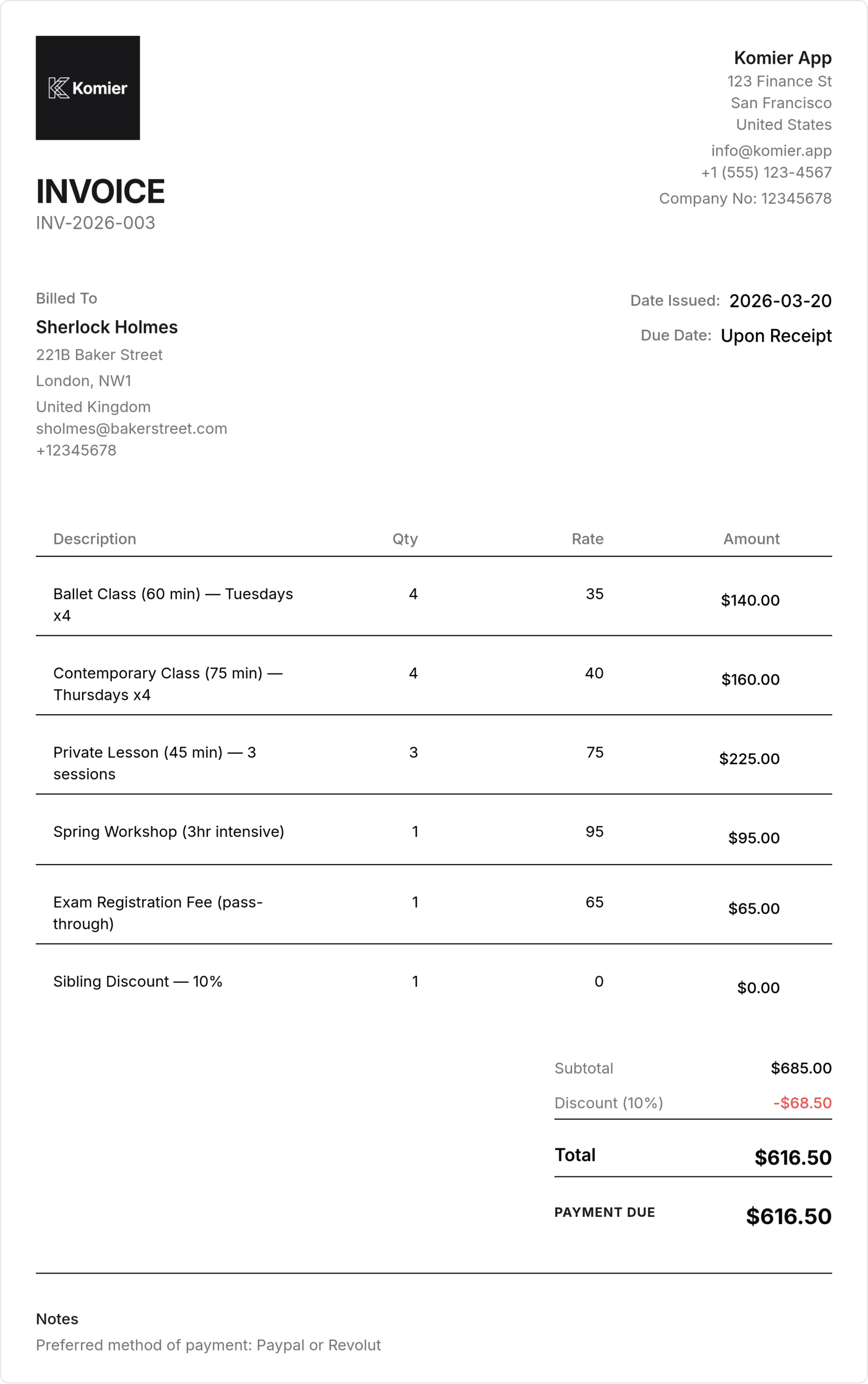
- Clear description of each service — class type, day and time, date range, and number of sessions
- Rate per class or per package, quantity, and total
- Discount applied if offering sibling discount, early payment discount, or promotional rate
- Any pass-through costs — costume hire, exam registration fees, competition entry fees
- Tax line if applicable
- Total amount due
- Payment due date and accepted payment methods
- Cancellation and make-up class policy if relevant
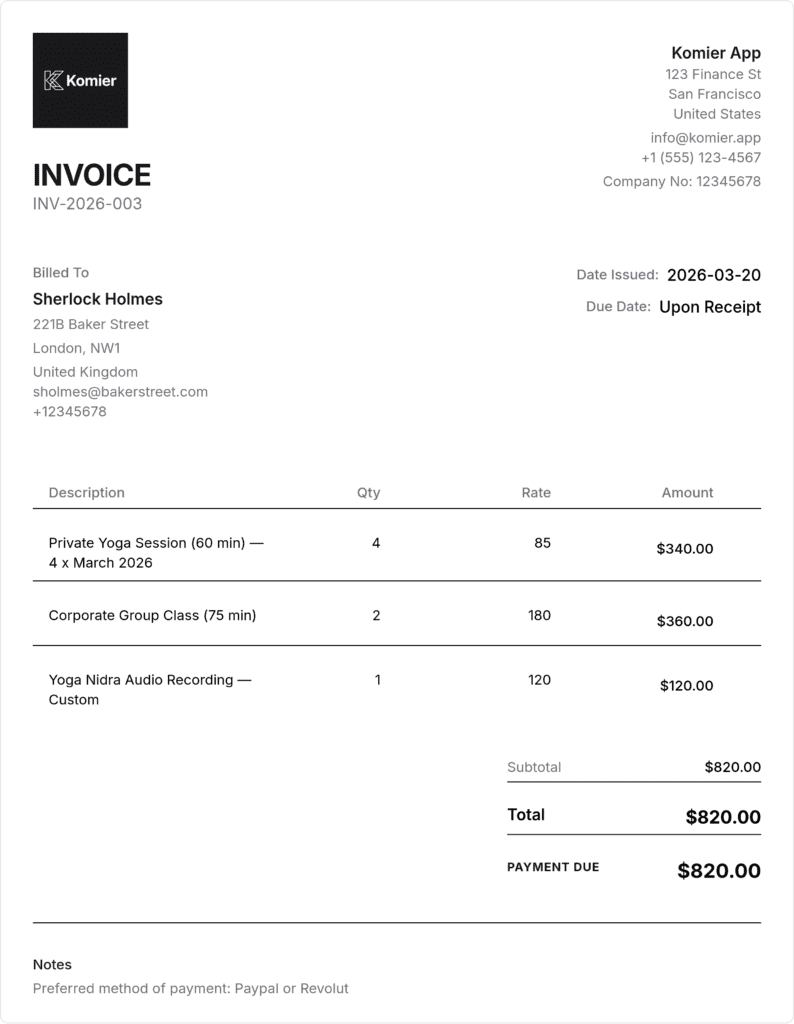
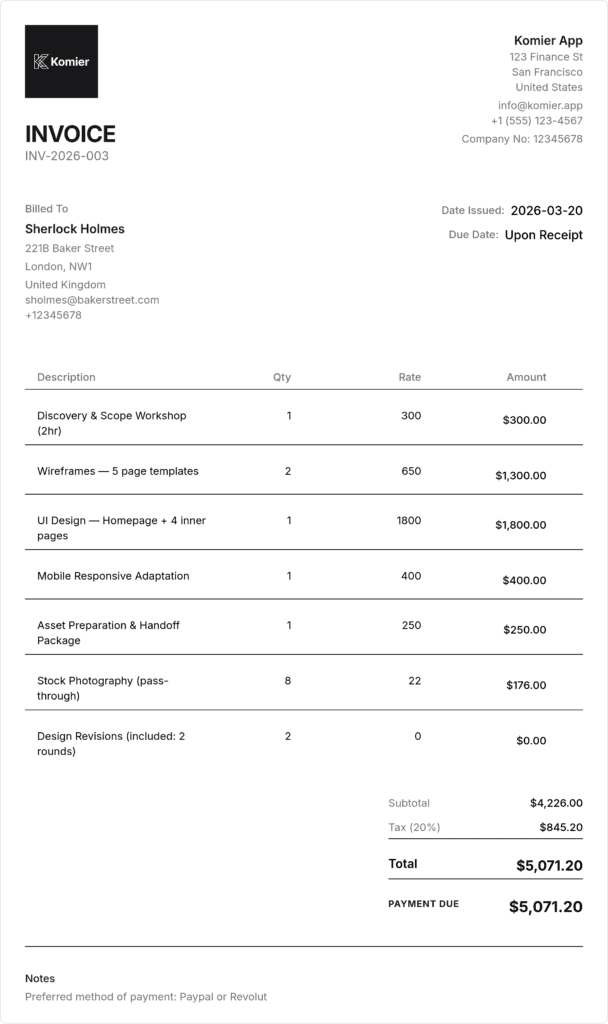
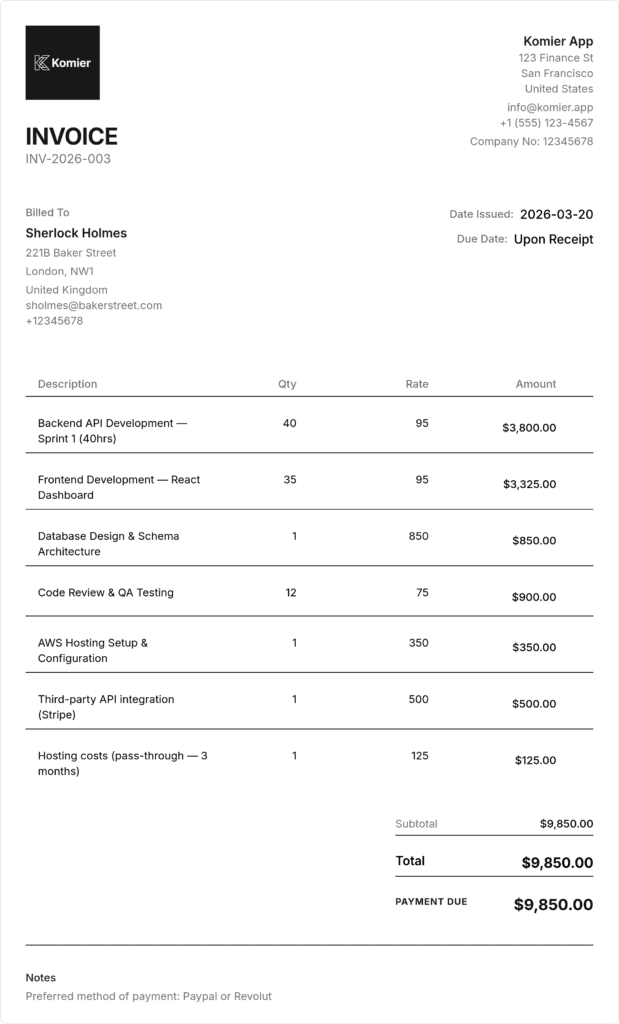
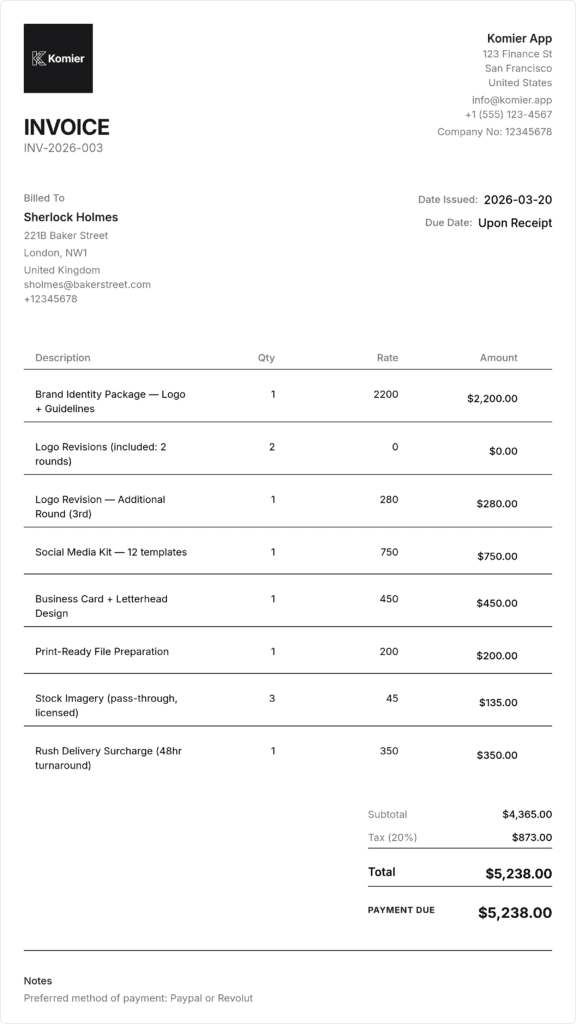
Sample Dance Teacher Invoice — Built in Komier
Invoicing for Different Dance Teaching Models
Weekly class billing — monthly invoicing
The most common billing structure for dance teachers is monthly: invoice at the start or end of the month for all classes in that period. In Komier, save each class type as an inventory item — ‘Ballet Class 60min’, ‘Contemporary 75min’, ‘Hip Hop Drop-In’ — with your standard rate. When invoicing a student for the month, select the relevant classes, set the quantity to the number of sessions attended or scheduled, and the total calculates automatically.
Drop-in class rates
For drop-in students, invoice per session rather than monthly. Generate a simple one-line invoice after each class — or batch-invoice weekly for students who attend multiple times. Having a saved drop-in rate in your Komier inventory means this takes under a minute per student.
Hourly rate work
For smaller tasks, amendments, consultancy, or art direction work billed by the hour, save your hourly rate as an inventory item. Log hours as a quantity and include the date range and brief description of work completed in each line item. Invoicing every two weeks or monthly depending on volume keeps amounts manageable and payment timelines predictable.
Private lesson invoicing
Private lessons are typically invoiced per session or as a block booking. For individual sessions, invoice within 24 hours of completion — the immediacy reduces the chance of delayed payment and keeps your records current. For block bookings — ’10 private lessons at $X’ — invoice the full block upfront before lessons begin. This is the professional standard for private tuition and protects you from students who stop attending mid-block without paying.
Workshops, intensives, and masterclasses
One-off events require event-specific invoicing. Create the event as an inventory item — ‘Summer Ballet Intensive 3hr’, ‘Salsa Masterclass — Guest Instructor’ — at the event price. Collect payment in advance by invoicing when the student registers. Komier lets you mark invoices as paid, so your registration list is automatically your payment confirmation list.
School and studio employment invoicing
If you are contracted to teach at a school or studio rather than directly to students, invoice the institution rather than individual students. Your invoice should itemise each class delivered — date, class type, duration — at your agreed sessional rate. Monthly invoicing to the institution is standard. Save the institution as a client in Komier and build the invoice from your saved class items — the institution gets a professional, itemised record and you get a clear payment trail.
Exam and competition pass-through fees
Dance students frequently incur examination registration fees, competition entry costs, and costume hire charges that teachers collect and pass on. Document these as separate line items on your invoice labelled clearly as pass-through costs at cost price. This protects you from any suggestion that you profited from the fee and gives parents a transparent record of exactly what they paid for.
Handling the Awkwardness of Asking Students to Pay
Many dance teachers find it genuinely uncomfortable to chase payment — the personal nature of the teaching relationship makes financial conversations feel socially risky. A professional invoice removes this discomfort by doing the asking for you. When you email a clean, professional invoice rather than sending a personal payment reminder, the transaction moves into a professional register where it belongs.
Some practices that help:
Invoice on a consistent, predictable schedule — same day each month — so students expect and budget for it
Set clear payment terms — 7 days is appropriate for individual clients — and note them on every invoice
Use Komier’s Notes reminder to follow up professionally if payment has not arrived by the due date
For block bookings, make payment a prerequisite for lesson commencement — not a hope at the end
Tracking Your Dance Business Finances
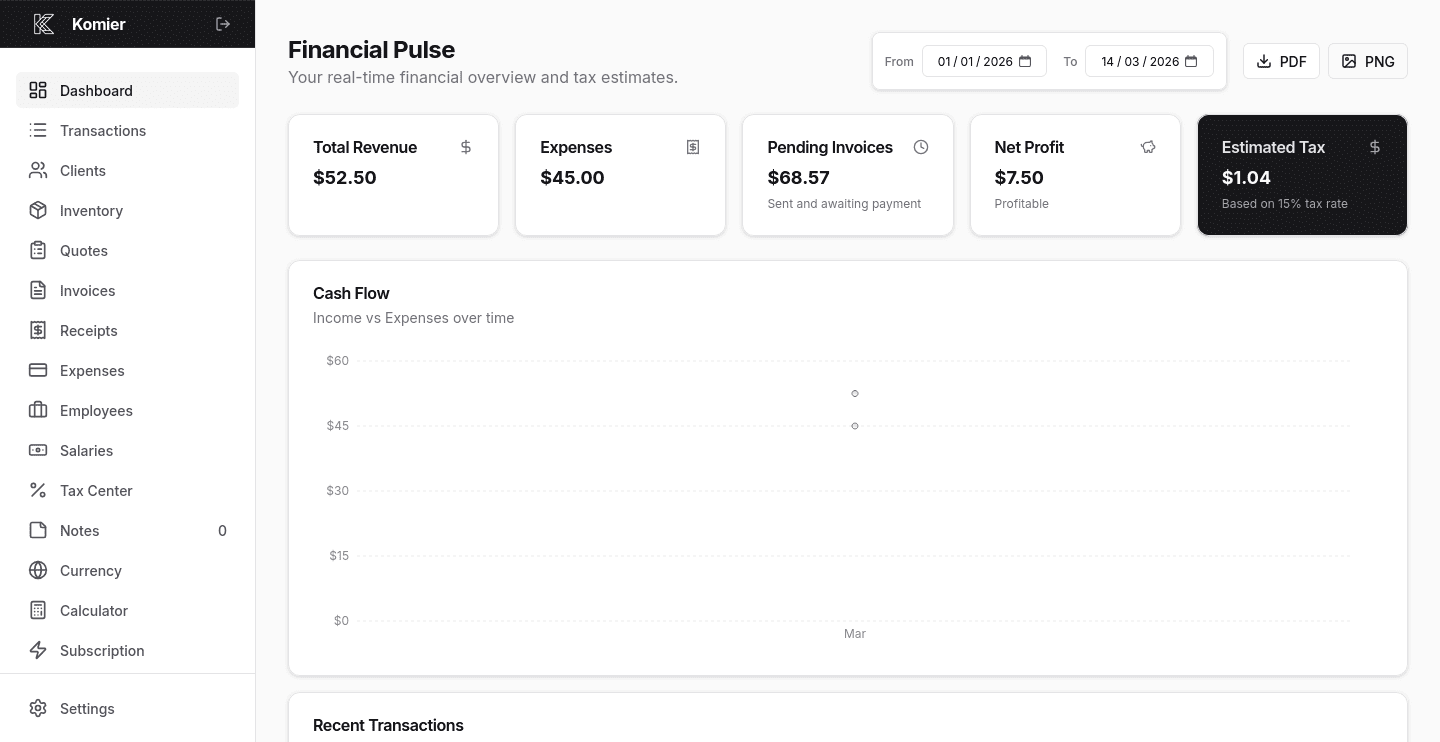
Beyond invoicing, Komier gives dance teachers the financial visibility that most independent teachers lack:
Revenue by student or class type — see which programs generate the most income
Expense tracking — log studio rental, music licences, costume costs, professional development, and exam fees as business expenses
Tax estimate — know your approximate income tax liability in real time throughout the year
Payslip generation — if you employ an assistant teacher or accompanist, generate their payslips from the same platform