How to Create a Professional Copywriter Invoice — Words Are Your Product, Bill Them Properly
Copywriters and content writers are among the most widely distributed freelancers in the global economy — working across every industry, every market, and every timezone. They are also among the most inconsistently billed, partly because writing feels intangible to clients who have not thought carefully about it, and partly because many writers are more comfortable with words than with the business of charging for them.
A professional copywriter invoice solves both problems. It makes the work tangible — clearly described, clearly priced, clearly due — and it removes the writer from the awkward position of having to personally negotiate every payment.

Your words earn your clients money. Your invoice earns you yours.
What a Copywriter Invoice Should Include
- Your name or writing business name, contact details, and any applicable tax registration
- Client name and billing contact — for agency work, include the agency and end-client project reference
- Invoice number and date
- Project or campaign name
- Line items: content type, word count or quantity, rate per unit or flat fee, and total
- Revision rounds included — and fees for additional rounds
- Rush fee if applicable — premium charged for expedited delivery
- Rights or usage licence if granting commercial use beyond standard deliverables
- Tax at applicable rate
- Total due, payment terms, and payment method
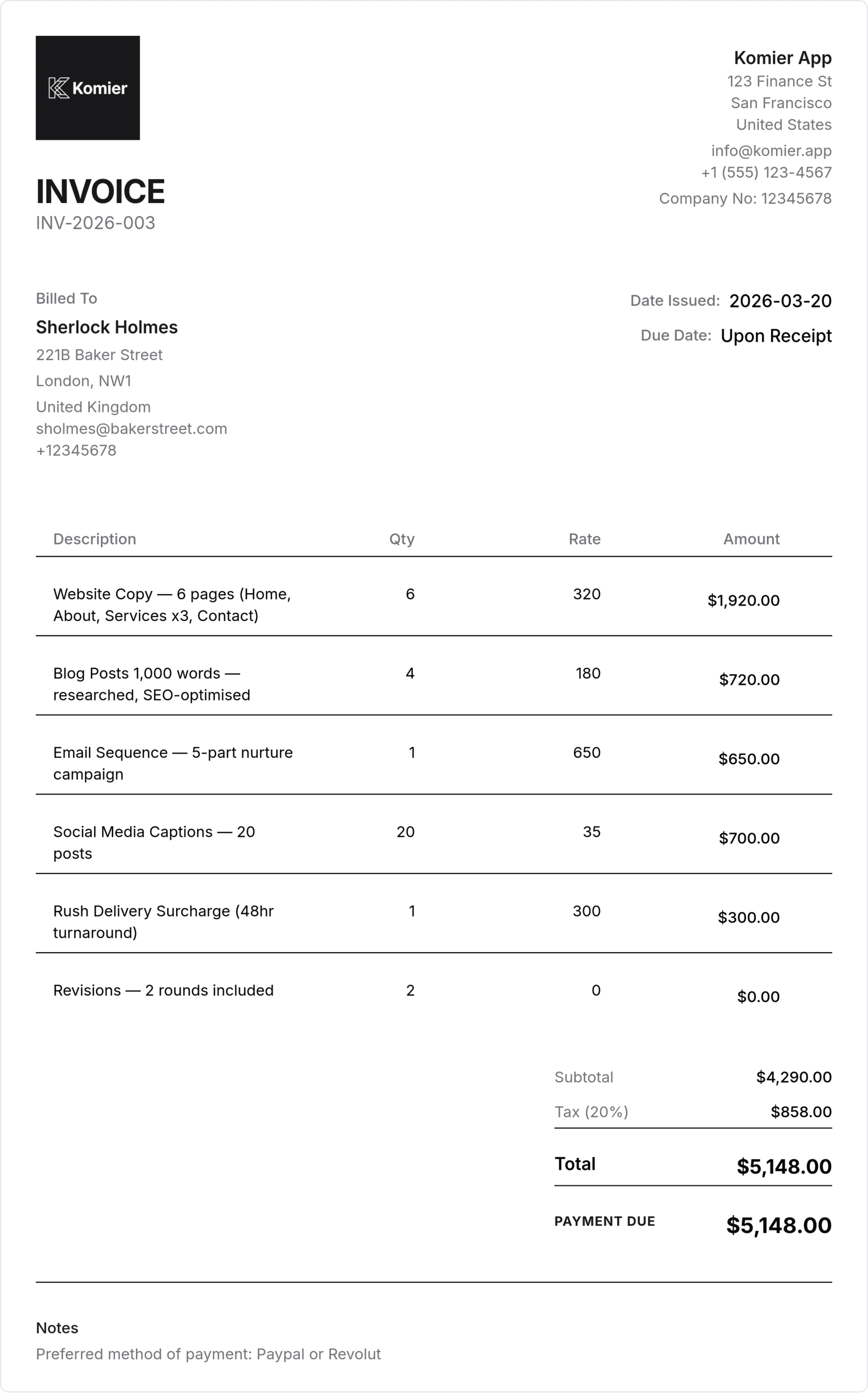
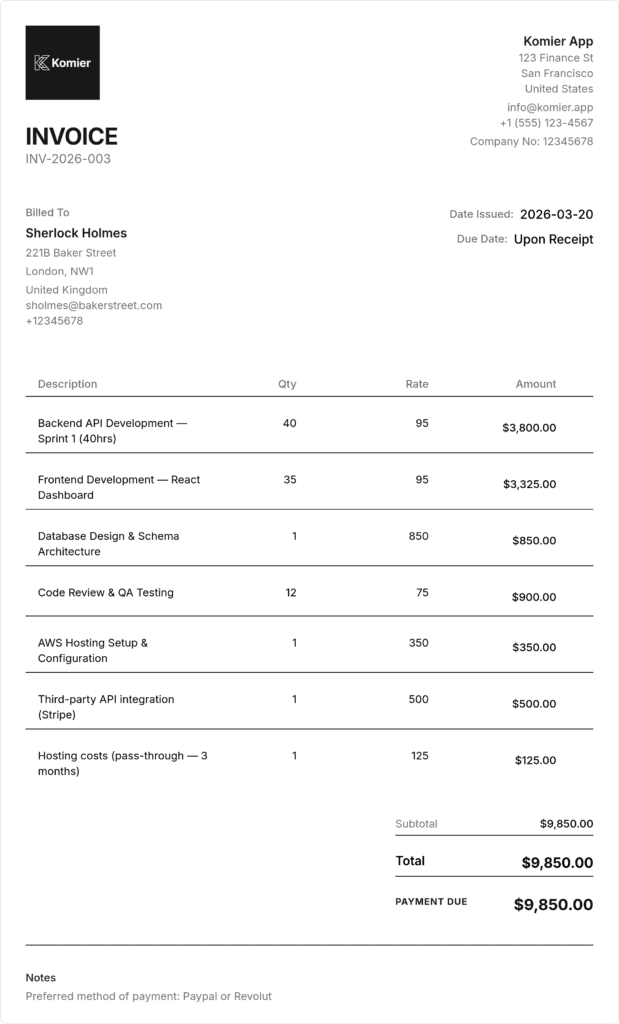
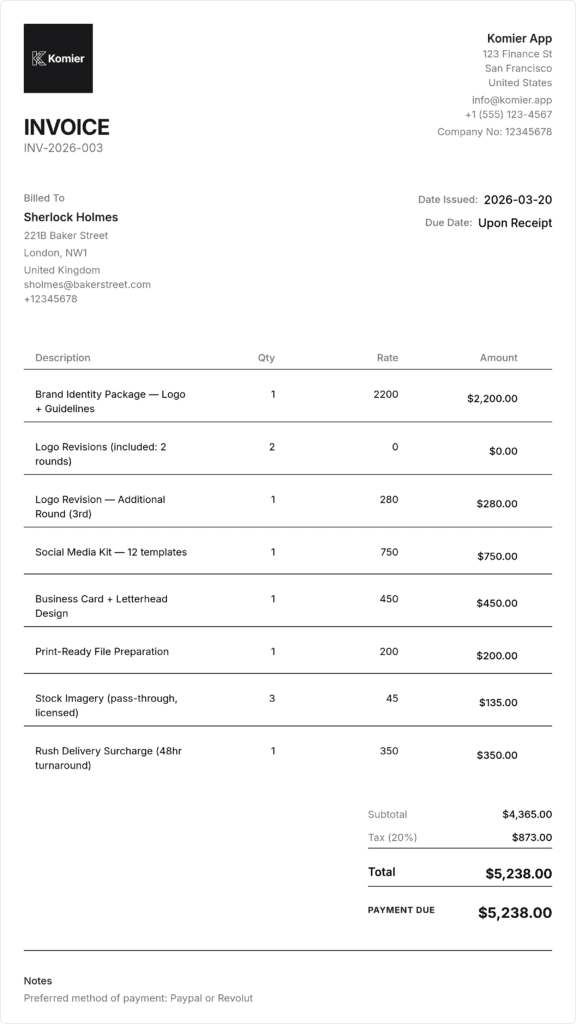
Sample Copywriter Invoice — Built in Komier
Billing Structures for Copywriters
Per-word rate
Per-word pricing is common for content writers, particularly for blog posts, articles, and web copy. Save ‘Blog Post per word’, ‘Web Copy per word’, ‘Article per word’ as inventory items in Komier at your rate. When invoicing, set the quantity to the word count of the delivered piece. This model rewards writing volume and is easy for clients to understand and compare.
Per-piece flat fee
Flat-fee pricing per deliverable is common for more complex or specialist content — email sequences, case studies, white papers, sales pages, and landing pages. Save each content type as a flat-fee inventory item. Clients know the cost upfront, you know your rate per deliverable, and the invoice is clean and unambiguous.
Hourly rate
For consulting, strategy work, content audits, and editorial direction — where the output is guidance rather than copy — hourly billing is appropriate. Save your hourly rate as an inventory item. Log hours honestly and include a brief description of what the hours covered in the description field.
Monthly retainer
A content retainer — a fixed monthly fee for a defined volume of content — is the most financially stable model for copywriters. Save ‘Content Retainer — [X] pieces/month’ as an inventory item at the agreed rate. Invoice at the start of each month with clear terms for what is included. Rush requests or out-of-scope work are invoiced additionally.
The revision clause
Every copywriter invoice should show revision rounds as explicit line items — included at zero charge or excluded with a fee. ‘Two revision rounds included — $0.00’ sets the expectation clearly. Save ‘Additional Revision Round’ in Komier at your applicable rate. When a client requests a third round, generate the charge without hesitation — it is on the invoice, it was agreed, and it is legitimate.
Standard copywriting fees typically include one-time use rights for the intended purpose. If a client wants to repurpose content across multiple platforms, translate it, use it in paid advertising, or licence it for extended periods, these are additional rights that carry additional value. Document the licence granted on your invoice as a separate line item.
International Copywriting and Multi-Currency Invoicing
Copywriters frequently work with international clients — US clients billing to UK writers in GBP, Australian clients billing Indian writers in USD, European agencies billing Colombian writers in EUR. Komier’s multi-currency invoicing with live exchange rates makes every international invoice as clean as a domestic one.