How to Track Taxes on Komier — Real-Time Tax Estimates So You Are Never Caught Off Guard
Tax surprises are one of the most common financial shocks for solopreneurs and small business owners. Revenue comes in, expenses go out, life moves fast — and then at the end of the quarter or year, the tax bill arrives and it is larger than expected. Komier’s Tax Center is designed to eliminate this entirely by keeping your estimated tax liability visible at all times.
This guide explains how the Komier Tax Center works, how to configure it for your jurisdiction, and how to use it as a live financial planning tool rather than a reactive calculation at year end.
How the Komier Tax Center Works
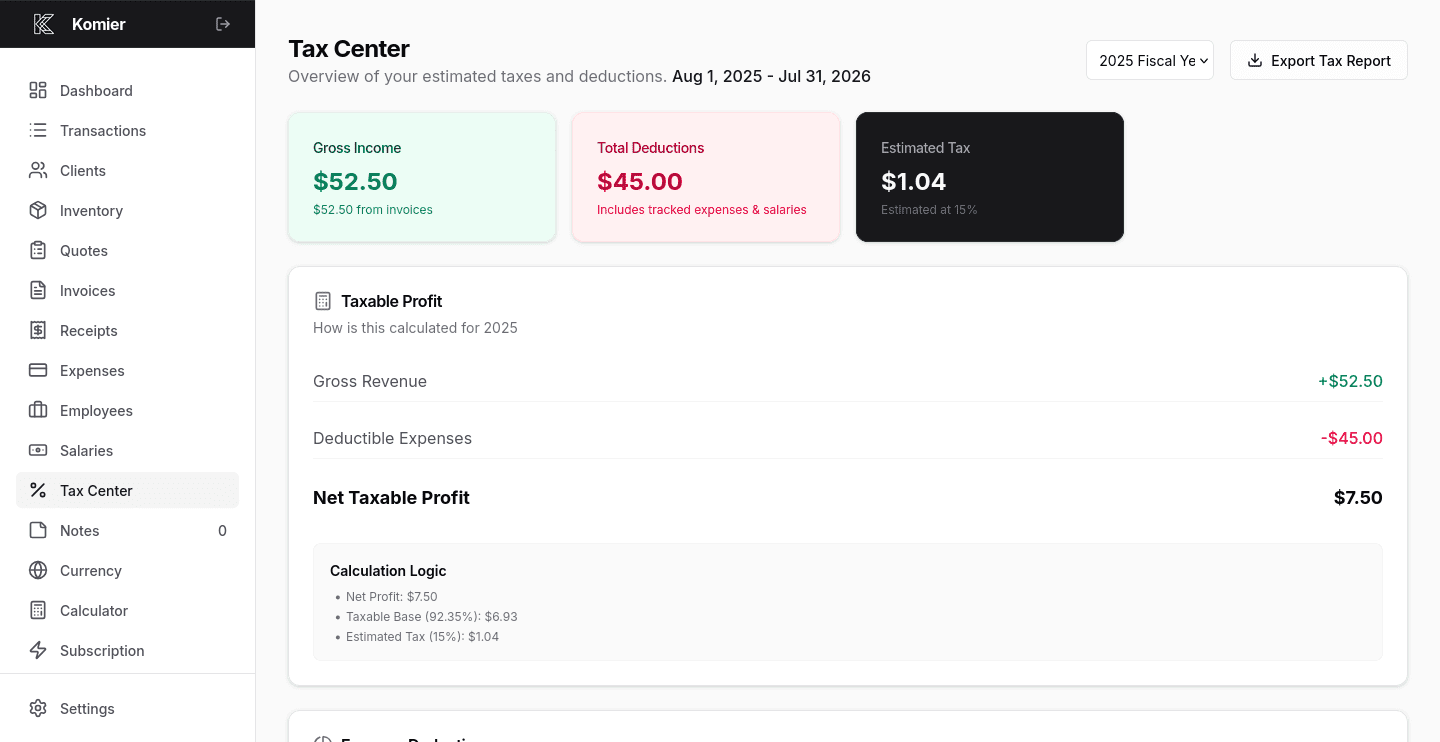
The Tax Center is a live component of your Komier dashboard. It calculates your estimated tax liability in real time based on two inputs: your current net profit and the tax rate you have configured in your account’s settings.
Every time your net profit changes — because a new invoice is paid, a new expense is logged, or a payslip is processed — your tax estimate recalculates automatically. You never have to open a spreadsheet or call your accountant to know roughly what you owe.
As your revenue and expenses update throughout the month and quarter, your tax estimate updates with them. Check it regularly — weekly is ideal — so you are always aware of your approximate liability.
Pro Tip: Set your tax rate slightly higher than your actual rate — for example, 20% if your real rate is 18%. This builds a small buffer and means you are more likely to have slightly more set aside than needed rather than slightly less.
Configuring for Your Jurisdiction
Komier is designed for a global user base, which means tax rates vary widely. Here is how to configure the Tax Center for common markets:
India — GST
For Indian freelancers and SMEs, configure your Default Tax Rate in the Settings. If you are registered under GST and your turnover exceeds the threshold, set your Applicable Tax Rate (labelled to GST) — 5%, 12%, 18%, or 28% depending on your goods or services category. Note that Komier’s estimate is a planning tool — always file your official returns through the GST portal with the guidance of a qualified professional.
Nigeria — VAT and Income Tax
Nigerian businesses subject to VAT should configure the Applicable Tax Rate (labelled to VAT) to 7.5%. For income tax estimation, enter your applicable personal income tax or company income tax rate for the Default Tax Rate. The Tax Center gives you a real-time estimate of your combined liability so quarterly tax planning becomes manageable.
Kenya — VAT and Corporate Tax
Kenyan businesses registered for VAT should enter the standard rate (currently 16%) for the Applicable Tax Rate (labelled to VAT).
South Africa — VAT and Tax
South African VAT-registered businesses should enter the standard rate (currently 15%) for the Applicable Tax Rate (labelled to VAT).
Global / Self-Employed
If you are a self-employed individual or solopreneur operating outside a formal VAT registration, set the Default Tax Rate to your applicable income tax or self-employment tax rate. For US-based users as a reference, the standard self-employment tax rate of 15.3% is the default shown in Komier — adjust this to your local equivalent.
What the Tax Center Does — and What It Does Not
It is important to be clear about the role of Komier’s Tax Center:
What it does Provides a real-time estimate of your tax liability based on your net profit and configured tax rate. Helps you plan and set aside funds throughout the year. Keeps your tax position visible so you are never surprised. |
What it does not do File your tax returns. Calculate complex multi-rate tax structures. Replace the advice of a qualified accountant or tax professional. Guarantee the accuracy of your final tax bill, which depends on deductions, allowances, and jurisdiction-specific rules that vary by individual. |
Komier is a planning and tracking tool. For official tax filing, always work with a certified accountant or use your jurisdiction’s official tax platform. The Tax Center makes that conversation easier by giving your accountant accurate, up-to-date records to work from.