How to Create a Professional Personal Trainer Invoice — Get Paid for Every Session, Package, and Program
Personal trainers build careers on results — transformations, performance gains, and client breakthroughs. But results do not pay the rent. Invoices do. And the gap between what personal trainers deliver and what they systematically get paid for is often wider than it should be, simply because invoicing has not been treated with the same seriousness as programming.
Whether you train clients in a commercial gym, a private studio, their home, or online — individually or in small groups — a professional personal trainer invoice is the document that turns completed sessions into confirmed income, every time.
You programme every session with precision. Apply the same discipline to your invoice.
What Personal Trainer Invoicing Gets Wrong
- Charging a flat monthly fee without documenting what sessions it covered — leaving disputes about how many were delivered
- Not invoicing no-shows — a missed session that is not invoiced is a session you delivered for free
- Informal payment arrangements — ‘just transfer me whenever’ creates late payment as a default
- No tracking of package progress — clients who paid for a 10-session block with no invoice have no formal record of what they committed to
- No expense tracking — supplement costs, gym access fees, CPD courses, equipment, and insurance all reduce taxable income but only if they are logged
What a Personal Trainer Invoice Should Include
- Your name or business name, contact details, and any professional registration or tax number
- Client name and billing contact
- Invoice number and date
- Line items: session type, duration, quantity, and rate
- Package or block booking description if billing a bundle
- Cancellation fee line if applicable
- Nutrition plan, program design, or assessment fees as separate items
- Tax at applicable rate
- Total due, payment terms, and payment method
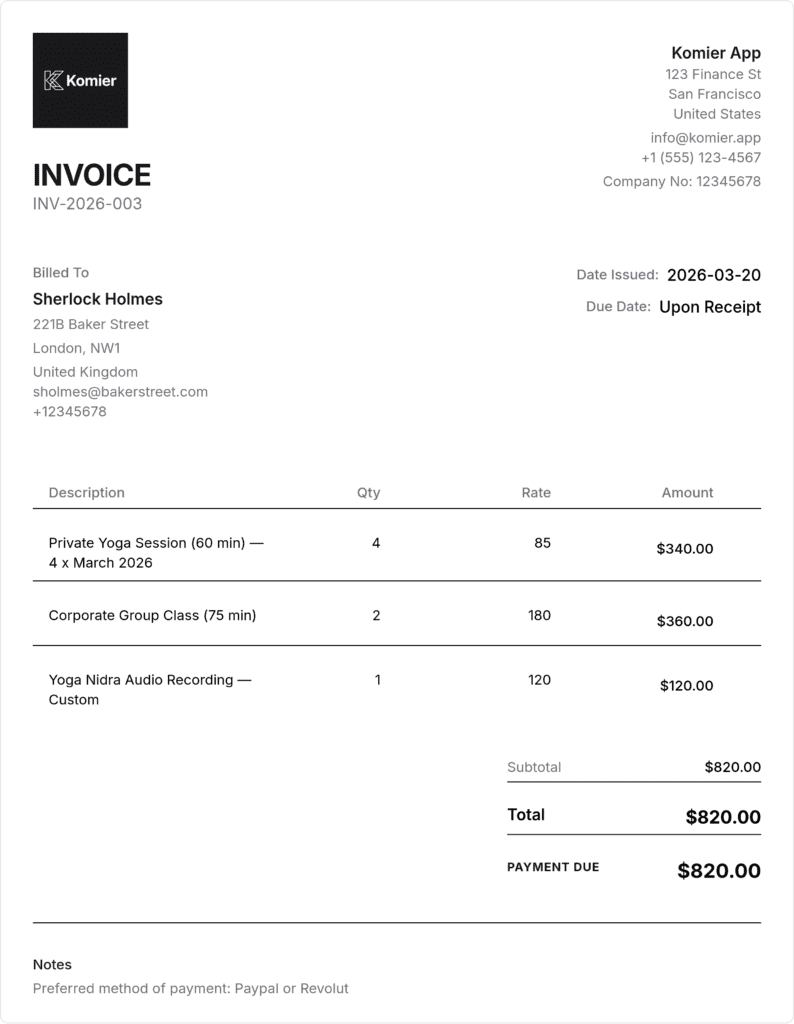
Sample Personal Trainer Invoice — Built in Komier
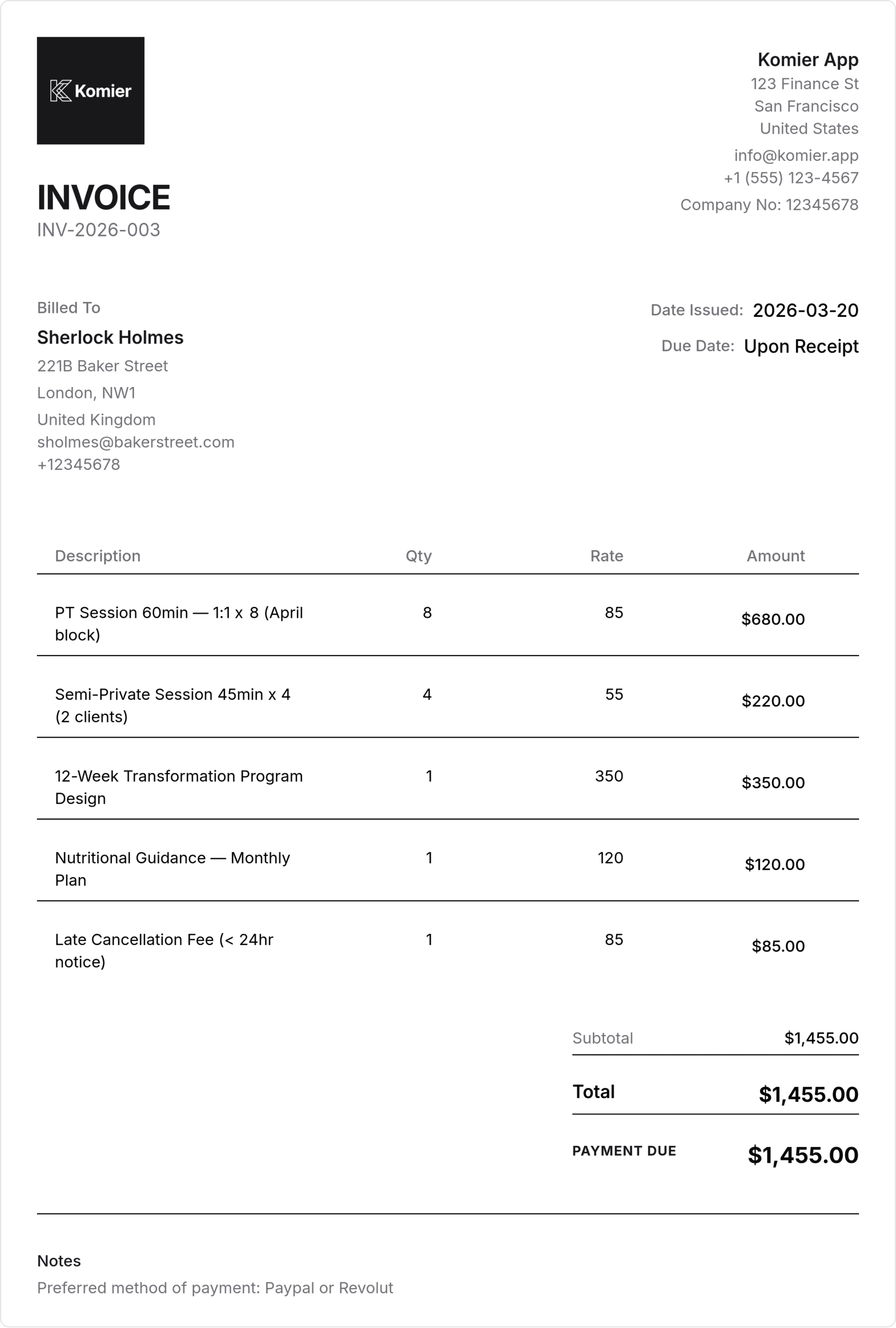
Billing Structures for Personal Trainers
Session-by-session billing
The simplest model — charge per session after delivery. Invoice weekly or bi-weekly to keep amounts manageable. Save each session type in Komier’s inventory: ’60-minute PT session’, ’45-minute PT session’, ‘Online session’. Set quantity to sessions completed in the period and include date ranges in the description.
Block booking packages
Selling 5, 10, or 20-session blocks upfront is the most financially stable model for personal trainers — you have guaranteed income, clients are committed, and the relationship has a clear structure. Invoice the full block before sessions begin. In Komier, save ‘PT Block — 10 Sessions’, ‘PT Block — 20 Sessions’ as inventory items at your block rate. Generate the invoice, collect payment, then deliver. Track session completion in your Notes.
Monthly program billing
For clients on structured 4, 8, or 12-week programs, monthly invoicing works well. The invoice covers the sessions delivered that month plus any program design or nutritional support included in the package. Breaking these into separate line items — even when bundled at a flat fee — shows the client the full value of what they received.
Online coaching retainers
Online personal training is typically billed as a monthly retainer — a fixed fee covering check-ins, program updates, nutritional guidance, and messaging support. Save the online coaching retainer as an inventory item in Komier. Invoice monthly, set 7-day payment terms, and let your dashboard track the recurring revenue automatically.
The no-show and cancellation policy
Every personal trainer needs a written cancellation policy — and it needs to appear on your invoice when it is enforced. Save ‘Late Cancellation Fee (less than 24 hours)’ as an inventory item at your session rate or a percentage of it. When a client misses a session within the cancellation window, add the line to their next invoice. Having it as a saved item removes the awkwardness of calculating and justifying it in the moment.
Your public liability insurance, professional indemnity, gym access fees, continuing education courses, and equipment are all potentially deductible business expenses. Log every one in Komier's expense tracker. They reduce your taxable profit — which means a lower tax bill at year end.
Managing Your PT Business Finances With Komier
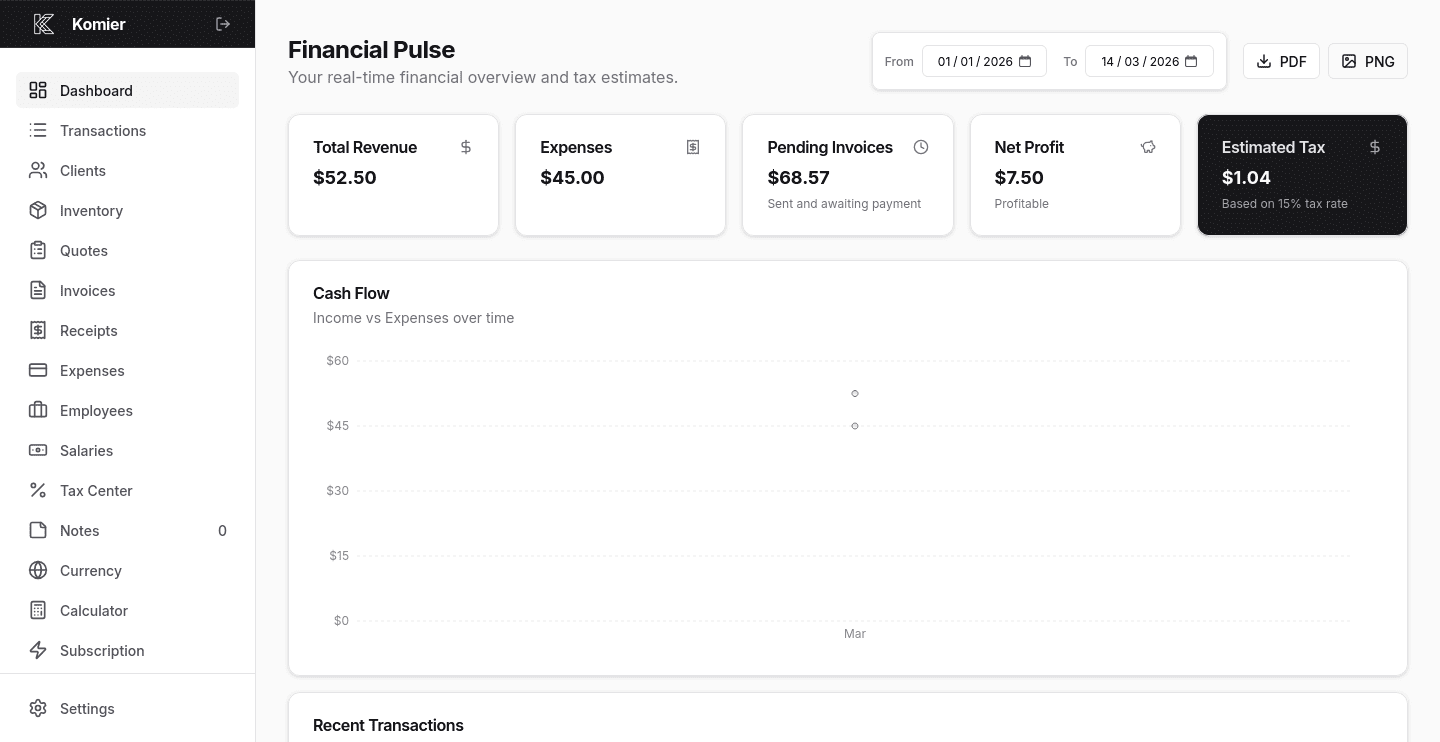
Real-time revenue dashboard — see your monthly and annual training income at a glance
Expense tracking — log all deductible costs as they occur, not at year end
Tax estimate — know your approximate liability throughout the year
Payslips — if you employ a receptionist, studio assistant, or sub-contractor trainer, generate their payslips from the same platform