How to Create a Professional Private Tutor Invoice — Private Tuition Billing Made Simple
Private tutoring is one of the fastest-growing freelance sectors globally — particularly in India, the UK, Singapore, and across Africa and the Middle East, where demand for supplemental academic support has grown dramatically in the past decade. Tutors are increasingly professional educators running genuine small businesses, and their invoicing should reflect that.
Whether you tutor in person, online, or both — across school subjects, university entrance preparation, professional exam coaching, or language learning — a professional tutor invoice creates the formal record that protects your time and income.
Private tutoring is a professional service. Invoice it as one — not as a favour with a suggested donation.
The Tutor Invoicing Problem
Most private tutors operate informally. Sessions are arranged by text, payment arrives by bank transfer with no reference, and the paper trail is a series of WhatsApp messages. This works until it does not — until a parent disputes how many sessions were held, until payment stops arriving, until the tutor cannot account for their annual income at tax time.
A professional tutor invoice — issued consistently, for every client, after every billing period — eliminates all of these problems. It creates a mutual understanding of what was agreed and what is owed.
What a Tutor Invoice Should Include
- Your full name or tutoring business name, contact details, and tax number if applicable
- Parent or student name and billing contact
- Invoice number and date
- Subject, level, and session duration for each line item
- Number of sessions in the billing period and dates covered
- Hourly or session rate
- Any additional charges — travel to home tutoring, materials, or assessment fees
- Tax if applicable in your jurisdiction
- Total due, payment terms, and preferred payment method
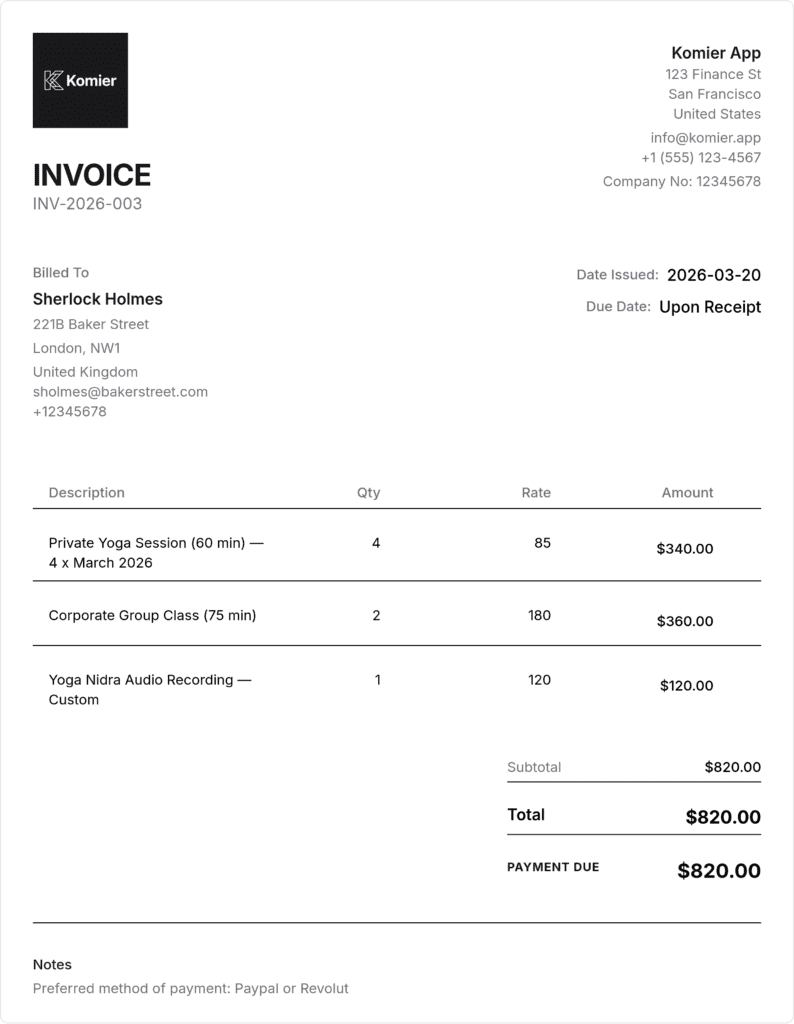
Sample Private Tutor Invoice — Built in Komier
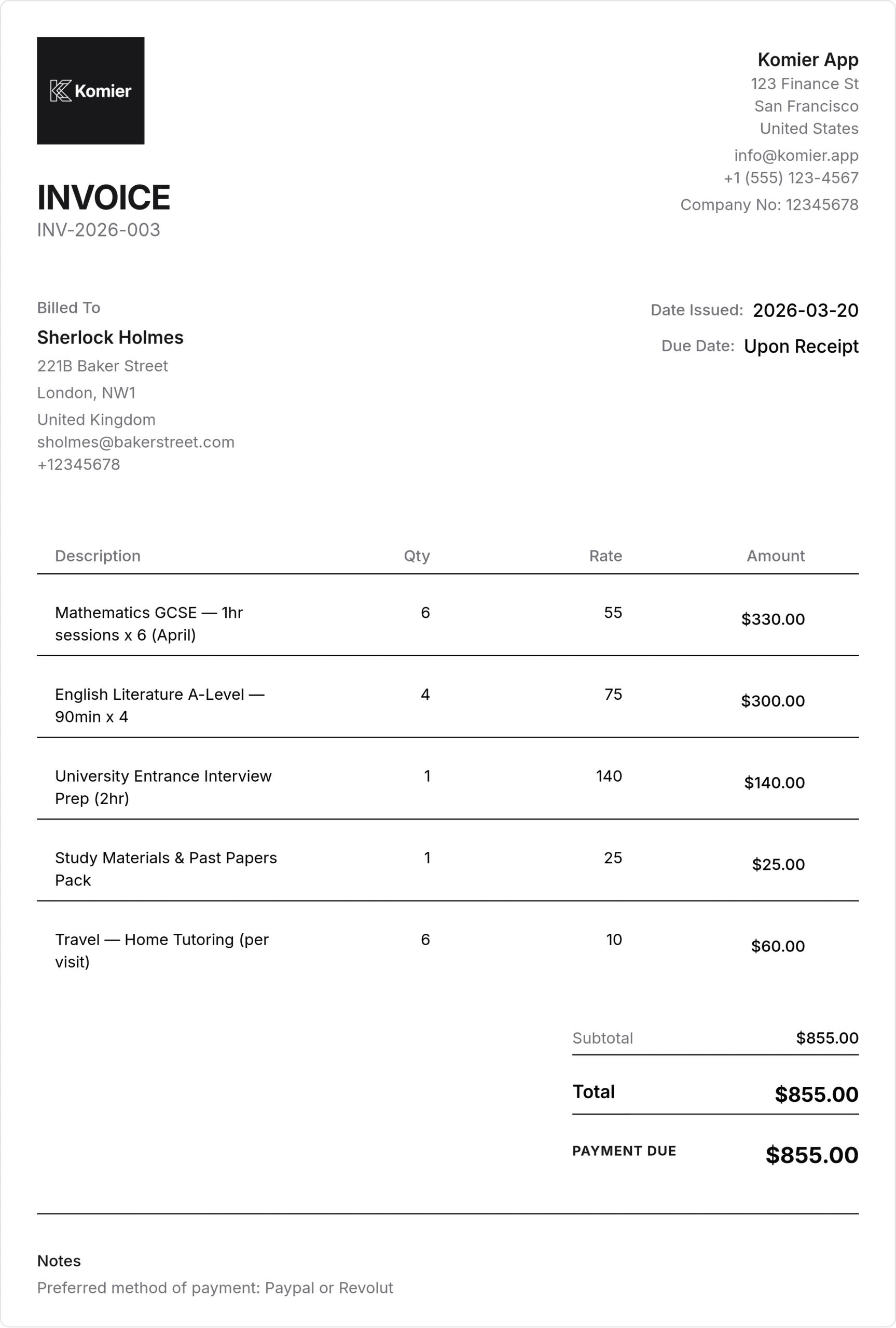
Billing Structures for Private Tutors
Monthly invoicing — the professional standard
Invoice monthly, at the start or end of the month, for all sessions held in that period. This is the most professional and easiest-to-manage billing cadence for private tutors. Save each subject and session length as an inventory item in Komier — ‘Maths GCSE 60min’, ‘English A-Level 90min’, ‘Online Session 60min’. When billing, select the items, set quantities to sessions held, and the invoice is ready in under a minute.
Term-based block invoicing
Many tutors in school systems prefer to invoice at the start of each term for the full term’s sessions. This gives the tutor guaranteed income and the family a single predictable payment. In Komier, create a block invoice labelled clearly with the term dates — ‘Spring Term Tutoring — January to April 2026 — 12 sessions’. Collect payment before the term begins.
Session-by-session billing
For adult learners, professional exam coaching, or clients who prefer pay-as-you-go, invoice after each session or weekly. Session-by-session billing keeps amounts small and reduces the risk of a large unpaid balance accumulating. Set 3 to 7-day payment terms for individual session invoices.
Online tutoring — international clients
Online tutoring has created a genuinely global market. Tutors in India teach students in the UAE. UK tutors coach IB students in Singapore. This creates multi-currency invoicing needs — Komier’s live currency exchange and multi-currency invoice generation handles this from the same account. Generate USD invoices for US or international clients, local currency invoices for domestic students.
Group and small group tutoring
For small group sessions — two to six students — invoice each family separately for their share, or invoice a lead family who splits the cost. Save your group session rate as an inventory item distinct from your individual rate. The lower per-student cost is a selling point; the total revenue per session hour is often higher than individual tutoring.
In many jurisdictions, educational services provided by qualified educators are exempt from VAT or sales tax. However, this varies significantly by country and by the nature of the tutoring. In the UK, private tutoring is generally VAT-exempt. In India, individual tutors below the GST threshold do not charge GST. Always confirm your specific tax position with a local accountant.
Tracking Your Tutoring Business Finances
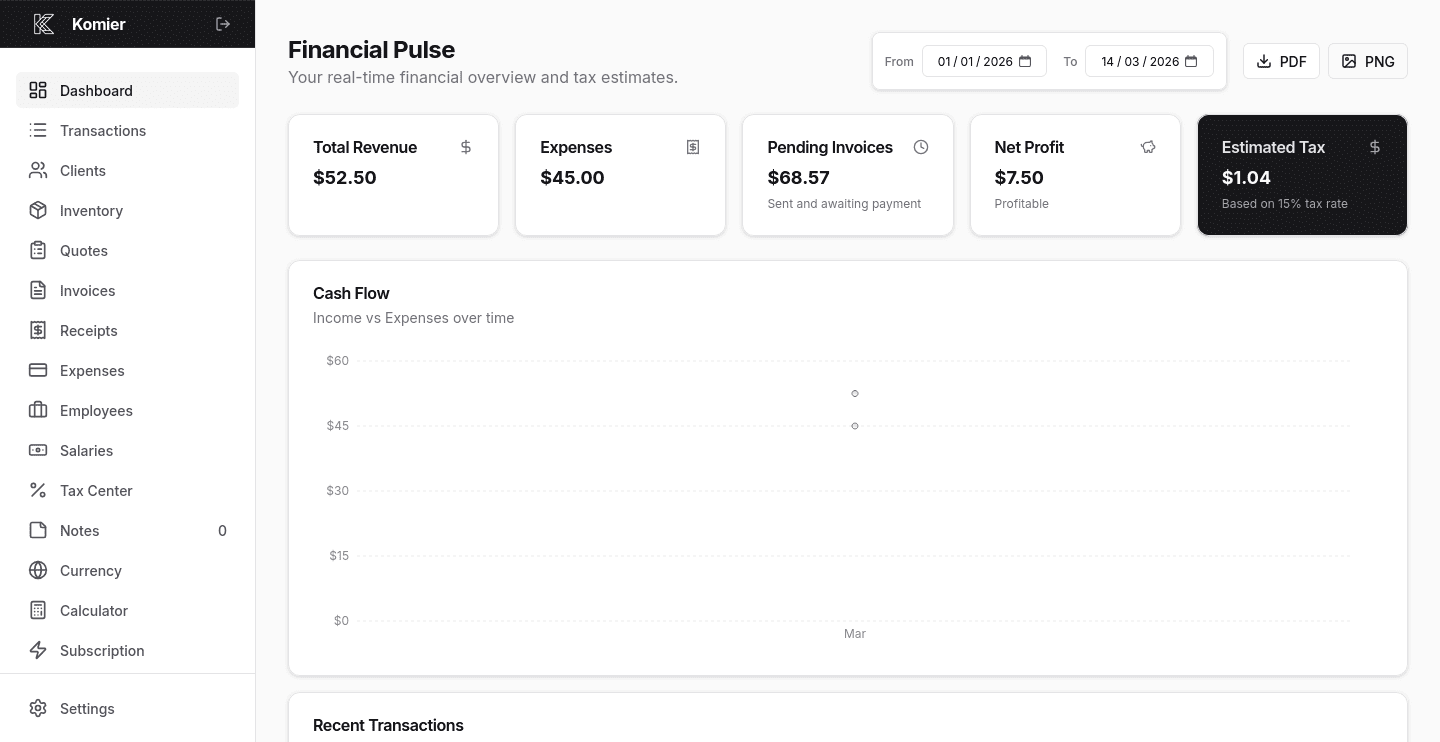
Revenue by subject or student — see which programmes generate the most income
Expense tracking — log books, curriculum materials, online platform subscriptions, and professional development
Tax estimate — monitor your running income tax liability throughout the year
Invoice history — complete record of every client, every session block, every payment